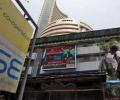
The S&P BSE Midcap and the S&P BSE Smallcap indices gained 0.3% and 0.5%, respectively

On the Sensex chart, M&M, Bharti Airtel, RIL, IndusInd Bank, ICICI Bank and Tata Steel were among major gainers -- rising as much as 4.68 per cent. Nifty rose 156.60 points to end at 18,212.35.

On the Sensex chart, HCL Tech, HDFC, Tech Mahindra, TCS, RIL, Sun Pharma and SBI were the major gainers, rising as much as 4.3 per cent. NSE Nifty gained 52.45 points to end at 18,055.75.
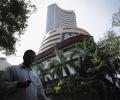
Broader gains were capped as investors awaited corporate results from major firms

Omkeshwar Singh, Head, Rank MF, a mutual fund investment platform, answers your queries.

'Like all long-term bull markets, the Indian stock market will continue to climb the proverbial wall of worry.'

With no major domestic market moving triggers this week, equities would continue to look at global factors, foreign fund movement and trend in the rupee for further direction, analysts said. "This week we have the August month F&O expiry where bulls are looking for rest after a gain in the August series," said Santosh Meena, head of research, Swastika Investmart Ltd. "There are not a lot of triggers but global cues, August month F&O expiry, and FIIs' behaviour will be important factors in the direction of the market," he noted.

SBI plunged over 3% after posting a 34.57% fall in net profit to Rs 2,538 crore for the quarter ended September 2016 on rise in provisions for non-performing loans.

Bank shares were the top gainer in early trades with Bank of Baroda up over 4%.

Infosys was the top gainer in the Sensex pack, rising 2.36 per cent, followed by HDFC Bank up 1.39 per cent.

Investors' wealth eroded by more than Rs 2.21 lakh crore in early trade on Wednesday, with the market witnessing a selling-off amid prospects of aggressive rate hikes by the US Federal Reserve to tackle high inflation, and sluggish global trends. In less than an hour of the start of trading on Wednesday, the key indices -- Sensex and Nifty -- were deep in the red and witnessed significant volatility, reflecting jittery investor sentiments. The market capitalisation of BSE-listed companies, which is also an indicator of wealth of investors, tumbled more than Rs 2.21 lakh crore to Rs 2,84,49,727.56 crore amid the 30-share Sensex falling 564.76 points to 60,006.32 points.
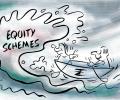
Gross inflows into active equity mutual fund (MF) schemes dipped 34 per cent month-on-month (MoM) -- to Rs 25,400 crore -- in April as investors applied brakes on lump sum investments amid a sharp upwards movement in the market. Gross inflows for March stood at Rs 38,641 crore. The sharp decline pulled the net inflows to a five-month low of Rs 6,480 crore, shows data released by the Association of Mutual Funds in India (Amfi).

Nikunj Saraf, Vice President Choice Wealth, answers your queries.

A spate of recent orders under the Indigenously Designed Developed and Manufactured (IDDM) category have led to investor focus on defence stocks. Actually, the defence index has been an outperformer for a long while with public sector undertakings (PSUs) like Hindustan Aeronautics (HAL), Bharat Electronics (BEL), Bharat Dynamics (BDL), Garden Reach Shipbuilders Engineers (GRSE), Cochin Shipyard and Goa Shipyard being beneficiaries of the policy.
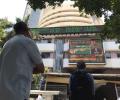
Investor wealth slumped by Rs 3.7 lakh crore on Monday, as the equity market recorded its biggest single-day fall in two months.

The Sensex closed the day at 27,490, higher by 479 points and the Nifty ended at 8331.95, up 150.45 points.

Omkeshwar Singh, Head, Rank MF, a mutual fund investment platform, answers your queries.

Nikunj Saraf, Vice President Choice Wealth, answers your mutual fund queries.

Equity markets halted their two-day rally on Friday, with the Sensex tumbling 714.53 points amid weak global equities and selling in index majors Infosys, ICICI Bank, HDFC Bank and Reliance Industries. Continuous foreign fund outflows also dented sentiments. The BSE benchmark Sensex tanked 714.53 points or 1.23 per cent to settle at 57,197.15. During the day, it plummeted 776.96 points or 1.34 per cent to 57,134.72. The NSE Nifty also declined 220.65 points or 1.27 per cent to 17,171.95.
Omkeshwar Singh, head, Rank MF, a mutual fund investment platform, answers your queries:

The laggards include FMCG (16 per cent), Energy (37 per cent) and Media (34 per cent).

Shares of Yes Bank may face selling pressure as the Reserve Bank-mandated three-year lock-in period for individual investors and exchange-traded funds is ending on Monday, according to analysts. The analysts expect distress on the bank counter on Monday as they expect investors, primarily the nine banks led by State Bank, which picked up almost 49 per cent of its stocks in March 2020 for Rs 10 per share -- at a premium of Rs 8 on the face value as part of the RBI bailout, making an exit. Exchange-traded funds are also likely to press the exit button.

From the pandemic shocks to state polls to global trends, a raft of sentiment drivers are expected to steer the Indian stock market in 2022 after a historic year of massive investor returns and milestones. The Union Budget, which will be closely watched for further reform moves, and quarterly earnings of corporates will be among the developments on investors' radar amid global central banks moving towards tighter interest regime in the wake of inflationary pressures. The year 2021 was rewarding in a big way for equity investors.

Omkeshwar Singh, head, Rank MF, a mutual fund investment platform, answers your queries.

VIX is meant to indicate investors' perception of the annual market volatility over the next 30 calendar days. The higher the value, the higher is the expected volatility and vice versa. VIX touched its historical peak of 85.13 on November 17, 2008, in the aftermath of the collapse of Lehman Brothers. In the past five years, it has stayed below 30.

Kotak Bank rose the most among Sensex scrips, spurting 2.92 per cent amid reports that LIC will up its stake in the private lender to 10 per cent. Gains in HCL Tech, TCS, Infosys, HDFC Bank, Bajaj Finance and Titan helped Sensex close in the green. NSE Nifty edged higher by 27.50 points to end at 17,053.95.
The broader markets, however, outperformed their larger peers.

Nifty made a gap up opening and moved higher after oil prices eased, relieving concerns of inflation.

BSE benchmark Sensex plummeted 778 points to close below the 55,500-level on Wednesday following a broad-based selloff in global markets as the Russia-Ukraine crisis escalated. The 30-share BSE index ended 778.38 points or 1.38 per cent lower at 55,468.90. Similarly, the NSE Nifty plunged 187.95 points or 1.12 per cent to 16,605.95.
The broader market outperformed with the S&P BSE Midcap down 0.3%, while the S&P BSE Smallcap was little changed.

Omkeshwar Singh, head, Rank MF, a mutual fund investment platform, answers your queries.

More than 10% (40 of 498 companies) have lost at least half their market value.

Omkeshwar Singh, head, Rank MF, a mutual fund investment platform, answers your queries.

Omkeshwar Singh, Head, Rank MF, a mutual fund investment platform, answers your queries.

Market chat expert Pranav Sanghavi offers some valuable tips on stock market.

From the 30-share pack, Asian Paints, Reliance Industries Limited, Bajaj Finance, Mahindra & Mahindra, Indusind Bank, Bajaj Finserv, Maruti Suzuki, HDFC Bank and UltraTech Cement were the major gainers, jumping up to 5.56 per cent.

Investors may increase exposure to mid and small-cap stocks as their risk-reward profile is more attractive currently, suggest Nitin Singh and Vinay Joseph.

"What would be your advice for investors?" 'Keep it simple. Don't panic.'

Axis Bank was the top gainer in the Sensex pack, surging around 5 per cent, followed by HDFC twins, ICICI Bank, Bajaj Finance and SBI. NSE Nifty zoomed 274.20 points to end at 14,982.

Omkeshwar Singh, Head, Rank MF, a mutual fund investment platform, answers your queries.
